
In an era where even the most sophisticated facilities can be exposed to evolving threats, airport security threat prevention is no longer simply about screening bags or controlling access.
It’s about building an architecture of intelligence-driven protection, operational readiness and multi-agency coordination — capabilities that directly impact your bottom line through avoided losses, continuity assurance and reputational safeguarding.
Recently, a real-world incident demonstrated how rapid threat interception prevented a mass-casualty scenario at a major airport.
For facility managers, risk executives and security directors, the lesson is clear: the same principles apply to any high-traffic, high-risk environment — including corporate HQs, cultivation facilities and critical infrastructure.
In this article we’ll unpack: what triggered the event, how professional security operations prevented it, the key lessons for your business, and how Shield Corporate Security’s tailored frameworks translate those lessons into actionable outcomes.
The Trigger: Why Airport Security Threat Prevention Matters More Than Ever
Across Australia and globally, the threat environment has shifted dramatically. According to the Cyber and Infrastructure Security Centre (CISC) within the Australian Government, aviation security must increasingly address “all hazards” — terrorism, unlawful interference and serious crime — not simply classic hijackings. cisc.gov.au
In fact, the Australian aviation sector’s layered-security model has been described as “world-class” due to its multi-layered (or “strength–in–depth”) approach — but that does not mean risk can be ignored.
Meanwhile, market research shows the Australian airport security market is projected to grow from USD 4.3 billion in 2025 to USD 10.2 billion by 2031, at a CAGR of 16.7% — a clear signal that investment is rising as threats evolve.
For organisations managing high-traffic or high-risk facilities (office towers, cannabis production sites, industrial campuses), the connection is simple: your environment has threat vectors, you have assets and people, and you need “airport-level” standards of threat prevention.
That means going beyond the screeners at the gate — envision intelligence sharing, behavioural-threat assessment, strategic consulting and operational training.
Let’s walk through a recent event that illustrates how effective airport security threat prevention works — and how it speaks to wider facility-security applications.
Cartersville man charged federally after allegedly threatening to “shoot up the airport”
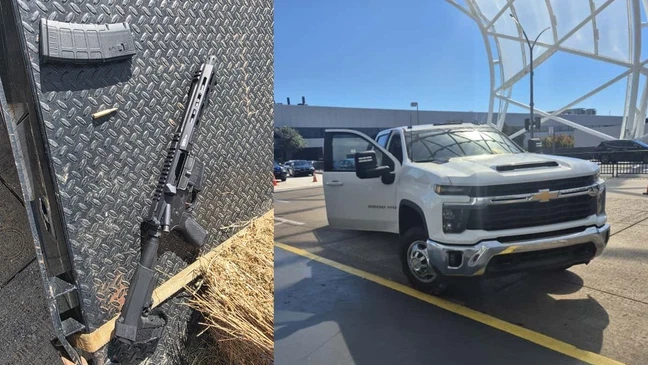
On 20 October 2025, according to open reports, a coordinated intelligence-driven response prevented a potential mass-casualty event at a major global airport (Hartsfield-Jackson, USA). Within 14 minutes of receiving credible intelligence, officers neutralised an armed suspect threatening to “shoot up the airport”. While the incident was outside Australia, the scenario is entirely relevant: rapid response, integrated intelligence, and operational readiness prevented catastrophe.
Key operational actions included:
-
Intelligence sharing between jurisdictions allowed rapid mobilisation of resources.
-
Behavioural threat assessment by alert third-parties (“see something, say something”) triggered early intervention.
-
Tactical response teams located, identified and arrested the suspect prior to reaching critical passenger areas.
-
A vehicle associated with the suspect was found containing an AR-15 and multiple rounds — underscoring that perimeter control and vehicle screening are just as relevant as passenger screening.
For you as a security manager or risk executive, consider this: if a terrorist-style attack can be thwarted in under 15 minutes at a major airport, the same proactive architecture applied in your facility could save millions of dollars in loss, downtime, reputational damage or regulatory non-compliance.
Source: ( USA Attorney’s office )
Translating Airport Security Threat Prevention into Your Environment
Identifying your unique threat vectors
Start by asking: what are the key vulnerabilities in your facility? For high-traffic corporate offices, it may be tailgating, social engineering, or unauthorised access after hours. For medicinal-cannabis sites, the vectors may include theft of product, organised crime infiltration, insider threat or perimeter breaches.
Your aviation-style security architecture should include:
-
Intelligence-driven surveillance: Real-time data from access control, CCTV, open-source intelligence, local law enforcement channels.
-
Behavioural-threat detection: Training staff to spot anomalies, suspicious behaviour, unauthorised loitering or off-pattern movement.
-
Layered access and perimeter control: Just as airports deploy screening, checkpoints and vehicle inspection, your facility needs perimeter checks, vehicle gates, credentials and barrier systems.
-
Tactical readiness: Security guards and response teams trained and resourced to act — not just monitor. Response time matters.
-
Multi-agency coordination: As airports coordinate with local, state and federal agencies, your facility may need alignment with regulatory bodies (e.g., cannabis licensing), local police, and internal teams (operations, IT, HR).
Strategic consulting and risk-management frameworks
At the strategic level, you need more than day-to-day operations.
You require a comprehensive risk management framework that aligns with corporate governance, compliance and business continuity.
That’s one of the “Four Pillars” of Shield’s approach: security operations excellence, strategic consulting, specialised cannabis security, and comprehensive risk management.
For example:
-
Risk-assessment audit: Identify vulnerabilities in your security architecture. For a cannabis facility, for example, assess product diversion risk, unauthorized access, insider sabotage, cyber-physical convergence.
-
Security consulting: Develop tailored mitigation strategies—placing physical security, surveillance systems, access control, incident-response plans, training programmes.
-
Operational delivery & training: Use proven operational experience to train guards, security staff and internal stakeholders. Shield’s expertise in firearms, close-personal protection, and high-risk facility guarding gives you tactical depth.
-
Business continuity and compliance: Align security controls with regulatory frameworks (e.g., cannabis licensing, workplace health & safety, privacy laws) and ensure your security posture supports organisational resilience.
Tactical Implementation: Five Steps to Elevate Your Facility’s Security Posture
Below is a practical roadmap derived from aviation-style threat prevention, adapted for your high-traffic or high-risk environment.
1. Establish an Intelligence-Driven Threat Detection System
-
Ensure you have real-time surveillance—not just cameras, but analytics, AI-driven detection of anomalies, open-source monitoring (e.g., social media, local intelligence).
-
Build alerts and dashboards so that threat indicators trigger defined workflows.
-
Link up with external agencies where possible (local police, regulatory bodies) to receive credible intelligence and act early.
2. Deploy Behavioural Threat Awareness Across the Organisation
-
Train every staff member — not just security guards — in the “see something, say something” mindset.
-
Use scenario-based training: tailgating attempts, unauthorised vehicle parking, insider threat behaviour changes.
-
Incorporate this into your incident-reporting process — with clear escalation paths and feedback loops.
3. Reinforce the Layers of Security (Perimeter → Access → Response)
-
Implement a layered security architecture: perimeter fencing, vehicle screening, pedestrian access control, asset-location monitoring, secure zones.
-
Use credentialing, biometric verification or layered access for zones that store high-value or high-risk assets.
-
Monitor vehicle movements, parking lots, loading docks — these are increasingly used as attack vectors, as seen in the airport case.
-
Simulate breach scenarios: what happens if an intruder reaches your “sterile zone”? Who responds? How fast?
4. Align Tactical Response and Security-Operations Excellence
-
Ensure security teams are trained, drilled and resourced to act — not just observe.
-
Create response checklists: escalation, lockdown, communications, law-enforcement liaison.
-
Run regular exercises (table-tops, live drills). Measure metrics: time to detect, time to engage, time to neutralise.
-
Track these metrics over time and report them to your exec team — this transforms “security expense” into “risk-mitigation investment”.
5. Integrate Strategic Consulting and Business Continuity
-
Use a comprehensive risk-management framework: identify threats, assess controls, evaluate residual risk, prioritise action.
-
Ensure your security strategy is aligned with business goals — e.g., minimal disruption to operations, regulatory compliance, reputational protection, product integrity (especially for cannabis).
-
Report security performance in terms that matter to leadership: risk exposure reduction, potential cost of failure, continuity assurance.
-
Periodically review and update your security programme as threats evolve and business conditions change.
Why This Matters to Your Target Audience
For Security Managers and Directors:
You’re responsible for deploying resources wisely. The ability to link security investment to measurable outcomes (e.g., prevented breaches, operational resilience) elevates you from “just guarding” to strategic leadership.
By adopting an aviation-style architecture of airport security threat prevention, you create an operational capability that stands up to scrutiny and aligns with corporate risk frameworks.
For Risk Management & Compliance Executives:
You need to ensure that security isn’t siloed but integrated with compliance, governance and business continuity. The four-pillar approach (operations, consulting, specialised security, risk management) ensures that your organisation’s security posture is comprehensive, not ad-hoc.
For Facility Managers, Operations Directors & Procurement Teams:
High-traffic facilities require seamless operations. Security must support, not hinder, business flow. By applying the aviation-style model, you gain both high-level protection and operational efficiency, reducing potential incidents that disrupt operations and cost money.
For Companies in Specialised Sectors (Corporate HQs, Cannabis, High-Risk Facilities):
These sectors face distinct threats — product theft, regulatory scrutiny, insider risk, high-value assets, or critical infrastructure status. The professional security solutions offered by Shield are tailored to these sectors, grounded in operational experience and innovative delivery.
Common Pitfalls and How to Avoid Them
-
Pitfall: Security is treated as cost, not investment.
Avoidance: Report security in terms of ROI: prevented losses, continuity protection, compliance risk reduction. -
Pitfall: Overreliance on a single layer of defence.
Avoidance: Adopt layered security—just as aviation uses screening + perimeter + intelligence. -
Pitfall: Lack of training or awareness among non-security staff.
Avoidance: Ensure behavioural-threat training is organisation-wide, not just for guards. -
Pitfall: Static security model in a dynamic threat environment.
Avoidance: Regular audits, scenario planning, evolving technology and response measures. -
Pitfall: No measurement of performance.
Avoidance: Establish metrics (detection time, response time, number of incidents prevented) and report them to senior leadership.
How Shield Corporate Security Delivers on Airport-Level Threat Prevention for Your Facility
At Shield Corporate Security, we apply a results-focused approach built on operational excellence, strategic consulting and customised solutions. Here’s how we translate aviation-style security into your context:
-
Security Operations Excellence: Our proven protection teams deploy tactical security operations, close personal protection, guarding and firearm-trained personnel.
-
Strategic Consulting: We perform comprehensive risk evaluations, audit security architecture and provide tailored strategic security analysis.
-
Specialised Cannabis Security: For cannabis cultivation and operations, we offer regulatory-aware security design, access control, asset protection and compliance.
-
Comprehensive Risk Management: We help you build a risk management framework that links security measures with business continuity, regulatory compliance and measurable outcomes.
By partnering with Shield, you gain access to both mission-ready operational capabilities and strategic frameworks that align with your organisation’s high-stakes environment.
Conclusion
In today’s complex environment, airport security threat prevention isn’t just for airports — the same principles apply to any organisation with significant assets, people, regulatory exposure or operational risk.
From intelligence-driven surveillance and behavioural-threat assessment through layered access control, tactical readiness and multi-agency coordination — these core capabilities form the backbone of a resilient security posture.
At Shield Corporate Security, we help organisations implement these capabilities seamlessly, through proven operational experience and strategic consultancy.
If you’re responsible for facility security, risk management or compliance in a high-traffic or high-risk environment, contact us — let’s discuss how we can deliver measurable security outcomes and ensure your organisation is protected, prepared and resilient.